 +44(0)8002084032



Andy Burnham has reopened the question of the UK’s long-term relationship with the EU. At Labour’s conference in September he said the options ran from staying as we are, through the customs union and the single market, to going “all the way” and rejoining.1,2 He plans to set those options out before the UK-EU summit in Brussels on 20 November.3,4,5
If you export, the useful question is what each option would change on the paperwork that goes with every shipment. This piece takes them one at a time. The short version is that only full membership is certain to remove the export declaration for trade with the EU, and nobody is proposing that before the next general election.
What’s on the table, and when
Burnham has listed four routes: keep the current arrangement, join a customs union, join the single market, or rejoin.1 Labour’s 2024 manifesto ruled out a return to the customs union, the single market and free movement,6 and on 26 October he said he wouldn’t propose any changes in this Parliament or “move ahead of the public”.3 He hasn’t ruled out offering voters a choice at the next general election, which is due by 2029.7
So the summit itself is narrower. It’s expected to sign off agreements already in negotiation.8 The main one for exporters is the SPS deal. SPS stands for sanitary and phytosanitary, which means the rules on food safety, animal health and plant health, so this is the deal covering food, plant and animal products. The other is a link between the UK and EU emissions trading schemes. Brussels has also shown it won’t hand out halfway deals easily. A UK proposal for a single market in goods alone was reportedly turned down by EU officials in May, who pointed to a customs union instead.9
At a glance
Option 1: Stay as we are, with the SPS deal
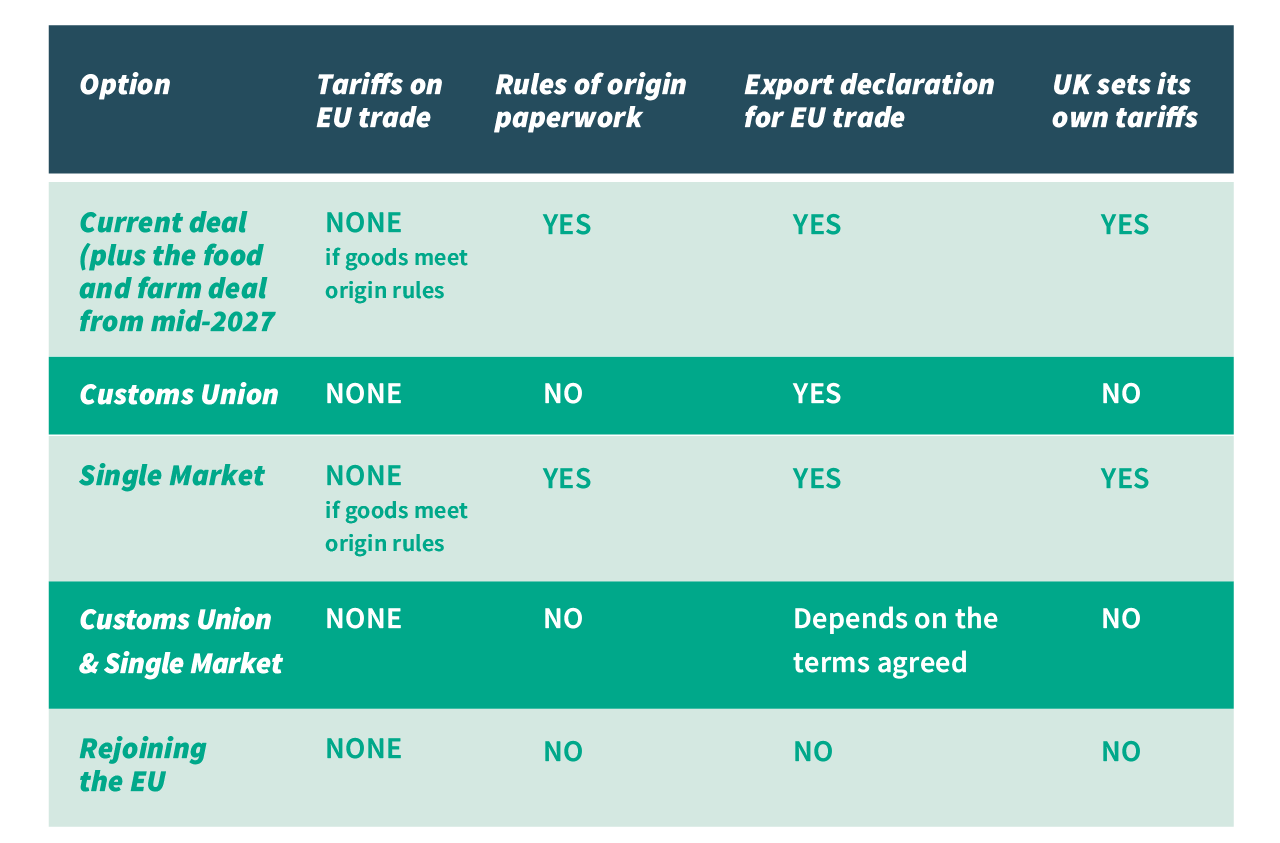
The current arrangement is the Trade and Cooperation Agreement. It allows tariff-free trade for goods that meet its rules of origin, and every consignment needs a customs declaration.10
The change already on its way is the SPS agreement, which the government intends to bring in from mid-2027. For most food, plant and animal products moving between Great Britain and the EU, it removes export health certificates, which can cost up to £200 per consignment, along with phytosanitary certificates and routine border checks. In return, UK businesses dealing in these goods will follow EU rules on food safety, animal health and plant health, including businesses that only sell at home.11
The government’s guidance says there will be no change to the digital systems for customs declarations.11 If you export food or drink, the SPS deal will cut cost and delay. If you export anything else, your paperwork stays as it is.
Option 2: Customs union
A customs union removes tariffs between its members and applies a common tariff to goods from outside.12 For UK exporters, that would mean no duty on EU trade and no need to prove where your goods were made, which is the rules-of-origin paperwork that sits behind tariff-free trade today.
The declaration would stay. Turkey has been in a customs union with the EU since the 1990s, and its goods still have to be declared to EU customs, with an A.TR movement certificate (a document showing the goods have already cleared customs inside the customs union) to claim nil duty.13 The Institute for Government notes that a customs union on its own leaves customs documentation, VAT checks and regulatory checks in place.12 Turkey’s version also leaves out basic agricultural products and some coal and steel.14
There’s a cost on the other side. Inside a customs union the UK couldn’t set its own tariffs, which limits its freedom to strike trade deals with countries such as India or the Gulf states.12 Burnham has said that every option brings winners and losers, particularly for businesses whose trade is mostly outside the EU.2 The trade gains would also be limited. Research from the Centre for European Reform found that leaving the customs union accounts for about a quarter of the fall in UK goods exports to the EU.15
Option 3: Single market
The single market goes further on rules. Members share product standards, so goods approved in one country can be sold across the rest without extra certification or checks.12 It also comes with free movement of people. Burnham has called for an “honest discussion” about that,16 and for now it sits behind the manifesto red lines.6
On its own, the single market leaves customs in place. Norway is in it through the European Economic Area but outside the customs union. Norwegian Customs requires exporters to declare goods leaving the country, including to the EU,17 and goods still have to meet rules of origin to travel tariff-free.18
This is the option with the biggest trade effect. The same Centre for European Reform research found that leaving the single market accounts for the large majority of what Brexit has cost UK trade with the EU.15
Option 3b: Customs union and the single market together
The deepest arrangement short of membership would be both, and it’s one possible outcome of the review. It would remove tariffs and rules-of-origin paperwork and cut most product checks on EU trade. Two of Europe’s smallest states are heading this way. Andorra and San Marino, both already in customs unions with the EU,14 signed association agreements on 19 October that give them access to the single market.19 Nothing comparable exists for an economy the size of the UK’s, and how much border paperwork would remain would depend on the terms agreed.
Option 4: Rejoining the EU
Full membership is the one option that takes the export declaration away for EU trade. Goods would move between the UK and EU member states as internal trade, with no customs declaration at the border. Exports to the US, India or anywhere else outside the EU would still need one.
It’s also the longest route. Burnham has said he’d like the UK back in the EU in his lifetime, but he won’t propose it in this Parliament,3 and he can’t imagine recommending the Euro or the Schengen area.16 Getting there would take an election won on that promise and then an application that every existing member state has to approve.
What this means for you now
Every structural option sits behind the next election, a negotiation and a period to put it in place. The SPS deal is the one change with a date on it, and it leaves customs declarations where they are. For the foreseeable future, every shipment to the EU will need an export declaration, much as it does today.
That makes the cost of each declaration worth looking at now rather than waiting on Brussels. Customs brokers typically charge £35 to £60 per declaration, and over a year of regular shipments the difference between that and a fixed fee adds up.
In Short
Whatever comes out of the review, your next shipment still needs a declaration. ExportDocuments lets you file it yourself in four steps for a flat £29.50, with no surcharges or handling fees.
Sources checked 26 October 2026.
- Euronews, “UK’s Burnham floats going ‘all the way’ and rejoining the EU”, 30 September 2026. euronews.com/2026/09/30/uks-burnham-floats-going-all-the-way-and-rejoining-the-eu
- Institute of Export & International Trade, “The Day in Trade: Burnham says rejoining EU is an option”, 30 September 2026. export.org.uk/insights/trade-news/the-day-in-trade-burnham-says-rejoining-eu-is-an-option-as-he-sets-out-sweeping-vision-and-theory-of-growth-for-uk/
- ITV News, “Burnham says UK’s Brexit deal isn’t ‘good enough’ but won’t push to rejoin EU”, 26 October 2026. itv.com/news/2026-10-26/burnham-says-uks-brexit-deal-isnt-good-enough-but-wont-push-to-rejoin-eu
- GOV.UK, “Prime Minister to attend UK-EU summit in Brussels on 20 November”, October 2026. gov.uk/government/news/prime-minister-to-attend-uk-eu-summit-in-brussels-on-20-november
- Council of the EU, “EU-UK summit to take place in Brussels on 20 November”, 12 October 2026. consilium.europa.eu/en/press/press-releases/2026/10/12/eu-uk-summit-to-take-place-in-brussels-on-20-november/
- Euronews, “Andy Burnham is rethinking the UK’s ties with the EU. What are his options?”, 2 October 2026. euronews.com/2026/10/02/andy-burnham-is-rethinking-the-uks-ties-with-the-eu-what-are-his-options
- The Irish Times, “Andy Burnham raises prospect of UK rejoining European Union after next election”, 29 September 2026. irishtimes.com/world/uk/2026/09/29/uk-prime-minister-raises-prospect-of-uk-rejoining-eu-after-next-election/
- House of Commons Library, “Debate on the UK applying to join the European Union”, October 2026. commonslibrary.parliament.uk/research-briefings/cdp-2025-0067/
- Institute of Export & International Trade, “The Day in Trade: EU rejects UK proposal for single market”, 26 May 2026. export.org.uk/insights/trade-news/the-day-in-trade-eu-rejects-uk-proposal-for-single-market-reeves-pushes-for-government-to-buy-british-and-iran-hopes-rise-and-fall/
- House of Lords Library, “UK-EU relations: Proposals for customs union and connections with the EU single market”, 22 January 2026. lordslibrary.parliament.uk/uk-eu-relations-proposals-for-customs-union-and-connections-with-the-eu-single-market/
- GOV.UK, “SPS agreement: preparing your business”. gov.uk/government/publications/sps-agreement-preparing-your-business/sps-agreement-preparing-your-business
- Institute for Government, “Customs union” explainer. instituteforgovernment.org.uk/article/explainer/customs-union
- Netherlands Chamber of Commerce (KVK), “Importing goods from Türkiye”. kvk.nl/en/international/importing-goods-from-turkiye
- Finnish Customs, “EU customs and fiscal territory”. tulli.fi/about-us/our-activities/eu-customs-and-fiscal-territory
- Centre for European Reform, John Springford and Anton Spisak, “The cost of Brexit, ten years on: The impact of leaving the customs union and single market on UK trade”, 18 June 2026. cer.eu/sites/default/files/JS_AS_brexit10_11.6.26.pdf
- ITV News, “Burnham: Time for ‘honest discussion’ about freedom of movement with EU”, 24 October 2026. itv.com/news/2026-10-24/burnham-time-for-honest-discussion-about-freedom-of-movement-with-eu
- Norwegian Customs, “Export declaration”. toll.no/en/corporate/export/export-declaration
- CBI, “Business view of the EU from Norway”. cbi.org.uk/media/1326/view-of-the-eu-from-norway.pdf
- Eunews, “EU, Andorra and San Marino sign association agreement”, 19 October 2026. eunews.it/en/2026/10/19/eu-andorra-and-san-marino-sign-association-agreement/